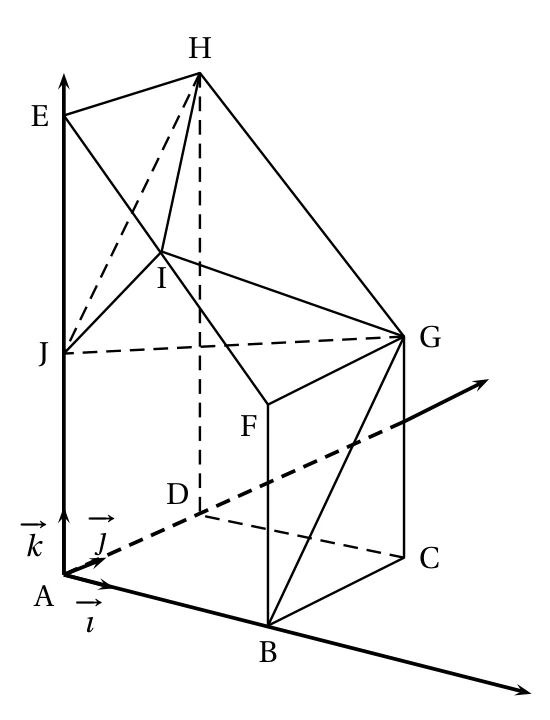
Le repère ( A ; ı ⃗ , ȷ ⃗ , k ⃗ ) \left(\mathrm{A}\,;\vec\imath,\vec\jmath,\vec k\right) ( A ; , , k ) ı ⃗ = 1 4 A B → \vec\imath=\dfrac14\overrightarrow{\mathrm{AB}} = 4 1 AB ȷ ⃗ = 1 4 A D → \vec\jmath=\dfrac14\overrightarrow{\mathrm{AD}} = 4 1 AD k ⃗ = 1 8 A E → \vec k=\dfrac18\overrightarrow{\mathrm{AE}} k = 8 1 AE
On en déduit A B → = 4 ı ⃗ \overrightarrow{\mathrm{AB}}=4\vec\imath AB = 4 A D → = 4 ȷ ⃗ \overrightarrow{\mathrm{AD}}=4\vec\jmath AD = 4 A E → = 8 k ⃗ \overrightarrow{\mathrm{AE}}=8\vec k AE = 8 k
A ( 0 ; 0 ; 0 ) , B ( 4 ; 0 ; 0 ) , D ( 0 ; 4 ; 0 ) , E ( 0 ; 0 ; 8 ) . \mathrm{A}(0\,;0\,;0),\qquad \mathrm{B}(4\,;0\,;0),\qquad \mathrm{D}(0\,;4\,;0),\qquad \mathrm{E}(0\,;0\,;8). A ( 0 ; 0 ; 0 ) , B ( 4 ; 0 ; 0 ) , D ( 0 ; 4 ; 0 ) , E ( 0 ; 0 ; 8 ) . On a B F → = 1 2 A E → = 4 k ⃗ \overrightarrow{\mathrm{BF}}=\dfrac12\overrightarrow{\mathrm{AE}}=4\vec k BF = 2 1 AE = 4 k F ( 4 ; 0 ; 4 ) \mathrm{F}(4\,;0\,;4) F ( 4 ; 0 ; 4 )
Le prisme est droit, donc F G → = A D → = 4 ȷ ⃗ \overrightarrow{\mathrm{FG}}=\overrightarrow{\mathrm{AD}}=4\vec\jmath FG = AD = 4 E H → = A D → = 4 ȷ ⃗ \overrightarrow{\mathrm{EH}}=\overrightarrow{\mathrm{AD}}=4\vec\jmath EH = AD = 4
G ( 4 ; 4 ; 4 ) , H ( 0 ; 4 ; 8 ) . \mathrm{G}(4\,;4\,;4),\qquad \mathrm{H}(0\,;4\,;8). G ( 4 ; 4 ; 4 ) , H ( 0 ; 4 ; 8 ) . Question 1.
Le point I \mathrm{I} I [ E F ] [\mathrm{EF}] [ EF ] E ( 0 ; 0 ; 8 ) \mathrm{E}(0\,;0\,;8) E ( 0 ; 0 ; 8 ) F ( 4 ; 0 ; 4 ) \mathrm{F}(4\,;0\,;4) F ( 4 ; 0 ; 4 )
I ( 0 + 4 2 ; 0 + 0 2 ; 8 + 4 2 ) = ( 2 ; 0 ; 6 ) . \mathrm{I}\left(\dfrac{0+4}2\,;\dfrac{0+0}2\,;\dfrac{8+4}2\right)=(2\,;0\,;6). I ( 2 0 + 4 ; 2 0 + 0 ; 2 8 + 4 ) = ( 2 ; 0 ; 6 ) . Le point J \mathrm{J} J [ A E ] [\mathrm{AE}] [ AE ] A ( 0 ; 0 ; 0 ) \mathrm{A}(0\,;0\,;0) A ( 0 ; 0 ; 0 ) E ( 0 ; 0 ; 8 ) \mathrm{E}(0\,;0\,;8) E ( 0 ; 0 ; 8 )
J ( 0 ; 0 ; 0 + 8 2 ) = ( 0 ; 0 ; 4 ) . \mathrm{J}\left(0\,;0\,;\dfrac{0+8}2\right)=(0\,;0\,;4). J ( 0 ; 0 ; 2 0 + 8 ) = ( 0 ; 0 ; 4 ) . Donc I ( 2 ; 0 ; 6 ) \mathrm{I}(2\,;0\,;6) I ( 2 ; 0 ; 6 ) J ( 0 ; 0 ; 4 ) \mathrm{J}(0\,;0\,;4) J ( 0 ; 0 ; 4 )
Réponse : I ( 2 ; 0 ; 6 ) \mathrm{I}(2\,;0\,;6) I ( 2 ; 0 ; 6 ) J ( 0 ; 0 ; 4 ) \mathrm{J}(0\,;0\,;4) J ( 0 ; 0 ; 4 )
Question 2. a)
On calcule les coordonnées de deux vecteurs du plan ( I G J ) (\mathrm{IGJ}) ( IGJ )
I G → ( 4 − 2 4 − 0 4 − 6 ) = ( 2 4 − 2 ) , I J → ( 0 − 2 0 − 0 4 − 6 ) = ( − 2 0 − 2 ) . \overrightarrow{\mathrm{IG}}\begin{pmatrix}4-2\\4-0\\4-6\end{pmatrix}=\begin{pmatrix}2\\4\\-2\end{pmatrix},\qquad \overrightarrow{\mathrm{IJ}}\begin{pmatrix}0-2\\0-0\\4-6\end{pmatrix}=\begin{pmatrix}-2\\0\\-2\end{pmatrix}. IG 4 − 2 4 − 0 4 − 6 = 2 4 − 2 , IJ 0 − 2 0 − 0 4 − 6 = − 2 0 − 2 . Ces vecteurs ne sont pas colinéaires : la deuxième coordonnée de I J → \overrightarrow{\mathrm{IJ}} IJ I G → \overrightarrow{\mathrm{IG}} IG λ \lambda λ I G → = λ I J → \overrightarrow{\mathrm{IG}}=\lambda\overrightarrow{\mathrm{IJ}} IG = λ IJ
Les points I \mathrm{I} I G \mathrm{G} G J \mathrm{J} J
On calcule les produits scalaires avec n ⃗ ( − 1 1 1 ) \vec n\begin{pmatrix}-1\\1\\1\end{pmatrix} n − 1 1 1
n ⃗ ⋅ I G → = − 1 × 2 + 1 × 4 + 1 × ( − 2 ) = − 2 + 4 − 2 = 0 , \vec n\cdot\overrightarrow{\mathrm{IG}}=-1\times2+1\times4+1\times(-2)=-2+4-2=0, n ⋅ IG = − 1 × 2 + 1 × 4 + 1 × ( − 2 ) = − 2 + 4 − 2 = 0 , n ⃗ ⋅ I J → = − 1 × ( − 2 ) + 1 × 0 + 1 × ( − 2 ) = 2 + 0 − 2 = 0. \vec n\cdot\overrightarrow{\mathrm{IJ}}=-1\times(-2)+1\times0+1\times(-2)=2+0-2=0. n ⋅ IJ = − 1 × ( − 2 ) + 1 × 0 + 1 × ( − 2 ) = 2 + 0 − 2 = 0. Le vecteur n ⃗ \vec n n ( I G J ) (\mathrm{IGJ}) ( IGJ )
Donc n ⃗ \vec n n ( I G J ) (\mathrm{IGJ}) ( IGJ )
Question 2. b)
Le vecteur n ⃗ ( − 1 1 1 ) \vec n\begin{pmatrix}-1\\1\\1\end{pmatrix} n − 1 1 1 ( I G J ) (\mathrm{IGJ}) ( IGJ )
− x + y + z + d = 0. -x+y+z+d=0. − x + y + z + d = 0. Le point I ( 2 ; 0 ; 6 ) \mathrm{I}(2\,;0\,;6) I ( 2 ; 0 ; 6 )
− 2 + 0 + 6 + d = 0 , d = − 4. -2+0+6+d=0,\qquad d=-4. − 2 + 0 + 6 + d = 0 , d = − 4. Vérification avec les deux autres points : pour G ( 4 ; 4 ; 4 ) \mathrm{G}(4\,;4\,;4) G ( 4 ; 4 ; 4 ) − 4 + 4 + 4 − 4 = 0 -4+4+4-4=0 − 4 + 4 + 4 − 4 = 0 J ( 0 ; 0 ; 4 ) \mathrm{J}(0\,;0\,;4) J ( 0 ; 0 ; 4 ) 0 + 0 + 4 − 4 = 0 0+0+4-4=0 0 + 0 + 4 − 4 = 0
Donc une équation cartésienne de ( I G J ) (\mathrm{IGJ}) ( IGJ ) − x + y + z − 4 = 0 -x+y+z-4=0 − x + y + z − 4 = 0
Réponse : ( I G J ) : − x + y + z − 4 = 0 (\mathrm{IGJ}) : -x+y+z-4=0 ( IGJ ) : − x + y + z − 4 = 0
Question 3.
La droite d d d ( I G J ) (\mathrm{IGJ}) ( IGJ ) n ⃗ ( − 1 1 1 ) \vec n\begin{pmatrix}-1\\1\\1\end{pmatrix} n − 1 1 1 d d d
La droite d d d H ( 0 ; 4 ; 8 ) \mathrm{H}(0\,;4\,;8) H ( 0 ; 4 ; 8 ) M ( x ; y ; z ) \mathrm{M}(x\,;y\,;z) M ( x ; y ; z ) d d d t t t H M → = t n ⃗ \overrightarrow{\mathrm{HM}}=t\vec n HM = t n
{ x − 0 = − t y − 4 = t z − 8 = t \begin{cases}x-0=-t\\y-4=t\\z-8=t\end{cases} ⎩ ⎨ ⎧ x − 0 = − t y − 4 = t z − 8 = t Donc une représentation paramétrique de d d d
{ x = − t y = 4 + t z = 8 + t ( t ∈ R ) . \begin{cases}x=-t\\y=4+t\\z=8+t\end{cases}\quad(t\in\mathbb{R}). ⎩ ⎨ ⎧ x = − t y = 4 + t z = 8 + t ( t ∈ R ) . Question 4.
Le projeté orthogonal L \mathrm{L} L H \mathrm{H} H ( I G J ) (\mathrm{IGJ}) ( IGJ ) d d d H \mathrm{H} H ( I G J ) (\mathrm{IGJ}) ( IGJ )
Ses coordonnées ( − t ; 4 + t ; 8 + t ) (-t\,;4+t\,;8+t) ( − t ; 4 + t ; 8 + t ) − x + y + z − 4 = 0 -x+y+z-4=0 − x + y + z − 4 = 0
− ( − t ) + ( 4 + t ) + ( 8 + t ) − 4 = 0. -(-t)+(4+t)+(8+t)-4=0. − ( − t ) + ( 4 + t ) + ( 8 + t ) − 4 = 0. On développe : t + 4 + t + 8 + t − 4 = 0 t+4+t+8+t-4=0 t + 4 + t + 8 + t − 4 = 0 3 t + 8 = 0 3t+8=0 3 t + 8 = 0 t = − 8 3 t=-\dfrac83 t = − 3 8
On remplace dans la représentation paramétrique :
x = 8 3 , y = 4 − 8 3 = 4 3 , z = 8 − 8 3 = 16 3 . x=\dfrac83,\qquad y=4-\dfrac83=\dfrac43,\qquad z=8-\dfrac83=\dfrac{16}3. x = 3 8 , y = 4 − 3 8 = 3 4 , z = 8 − 3 8 = 3 16 . Donc L ( 8 3 ; 4 3 ; 16 3 ) \mathrm{L}\left(\dfrac83\,;\dfrac43\,;\dfrac{16}3\right) L ( 3 8 ; 3 4 ; 3 16 )
Question 5.
La distance de H \mathrm{H} H ( I G J ) (\mathrm{IGJ}) ( IGJ ) H L \mathrm{HL} HL L \mathrm{L} L H \mathrm{H} H
On a :
H L → ( 8 3 − 0 4 3 − 4 16 3 − 8 ) = ( 8 3 − 8 3 − 8 3 ) . \overrightarrow{\mathrm{HL}}\begin{pmatrix}\dfrac83-0\\[1mm]\dfrac43-4\\[1mm]\dfrac{16}3-8\end{pmatrix}=\begin{pmatrix}\dfrac83\\[1mm]-\dfrac83\\[1mm]-\dfrac83\end{pmatrix}. HL 3 8 − 0 3 4 − 4 3 16 − 8 = 3 8 − 3 8 − 3 8 . Le repère étant orthonormé :
H L = ( 8 3 ) 2 + ( 8 3 ) 2 + ( 8 3 ) 2 = 3 × 64 9 = 8 3 3 = 8 3 3 . \mathrm{HL}=\sqrt{\left(\dfrac83\right)^2+\left(\dfrac83\right)^2+\left(\dfrac83\right)^2}=\sqrt{3\times\dfrac{64}9}=\dfrac83\sqrt3=\dfrac{8\sqrt3}3. HL = ( 3 8 ) 2 + ( 3 8 ) 2 + ( 3 8 ) 2 = 3 × 9 64 = 3 8 3 = 3 8 3 . Donc la distance de H \mathrm{H} H ( I G J ) (\mathrm{IGJ}) ( IGJ ) 8 3 3 ≈ 4,62 \dfrac{8\sqrt3}3\approx4{,}62 3 8 3 ≈ 4 , 62
Réponse : H L = 8 3 3 ≈ 4,62 \mathrm{HL}=\dfrac{8\sqrt3}3\approx4{,}62 HL = 3 8 3 ≈ 4 , 62
Question 6.
On a I G → ( 2 4 − 2 ) \overrightarrow{\mathrm{IG}}\begin{pmatrix}2\\4\\-2\end{pmatrix} IG 2 4 − 2 I J → ( − 2 0 − 2 ) \overrightarrow{\mathrm{IJ}}\begin{pmatrix}-2\\0\\-2\end{pmatrix} IJ − 2 0 − 2
On calcule le produit scalaire :
I G → ⋅ I J → = 2 × ( − 2 ) + 4 × 0 + ( − 2 ) × ( − 2 ) = − 4 + 0 + 4 = 0. \overrightarrow{\mathrm{IG}}\cdot\overrightarrow{\mathrm{IJ}}=2\times(-2)+4\times0+(-2)\times(-2)=-4+0+4=0. IG ⋅ IJ = 2 × ( − 2 ) + 4 × 0 + ( − 2 ) × ( − 2 ) = − 4 + 0 + 4 = 0. Les vecteurs I G → \overrightarrow{\mathrm{IG}} IG I J → \overrightarrow{\mathrm{IJ}} IJ
Donc le triangle I G J \mathrm{IGJ} IGJ I \mathrm{I} I
Question 7.
Aire de la base. Le triangle I G J \mathrm{IGJ} IGJ I \mathrm{I} I
I G = 2 2 + 4 2 + ( − 2 ) 2 = 24 = 2 6 , I J = ( − 2 ) 2 + 0 2 + ( − 2 ) 2 = 8 = 2 2 . \mathrm{IG}=\sqrt{2^2+4^2+(-2)^2}=\sqrt{24}=2\sqrt6,\qquad \mathrm{IJ}=\sqrt{(-2)^2+0^2+(-2)^2}=\sqrt8=2\sqrt2. IG = 2 2 + 4 2 + ( − 2 ) 2 = 24 = 2 6 , IJ = ( − 2 ) 2 + 0 2 + ( − 2 ) 2 = 8 = 2 2 . Son aire est :
A = 1 2 × I G × I J = 1 2 × 2 6 × 2 2 = 2 12 = 4 3 . \mathcal{A}=\dfrac12\times\mathrm{IG}\times\mathrm{IJ}=\dfrac12\times2\sqrt6\times2\sqrt2=2\sqrt{12}=4\sqrt3. A = 2 1 × IG × IJ = 2 1 × 2 6 × 2 2 = 2 12 = 4 3 . Hauteur. Dans le tétraèdre I G J H \mathrm{IGJH} IGJH I G J \mathrm{IGJ} IGJ ( I G J ) (\mathrm{IGJ}) ( IGJ ) H \mathrm{H} H H \mathrm{H} H h = H L = 8 3 3 h=\mathrm{HL}=\dfrac{8\sqrt3}3 h = HL = 3 8 3
Volume. D'après la formule V = 1 3 × ( aire de la base ) × hauteur V=\dfrac13\times(\text{aire de la base})\times\text{hauteur} V = 3 1 × ( aire de la base ) × hauteur
V = 1 3 × 4 3 × 8 3 3 = 1 3 × 32 × 3 3 = 32 3 . V=\dfrac13\times4\sqrt3\times\dfrac{8\sqrt3}3=\dfrac13\times\dfrac{32\times3}3=\dfrac{32}3. V = 3 1 × 4 3 × 3 8 3 = 3 1 × 3 32 × 3 = 3 32 . Donc le volume du tétraèdre I G J H \mathrm{IGJH} IGJH 32 3 \dfrac{32}3 3 32
Réponse : V = 32 3 V=\dfrac{32}3 V = 3 32
Points clés attendus
Coordonnées des sommets déduites de ı ⃗ = 1 4 A B → \vec\imath=\dfrac14\overrightarrow{\mathrm{AB}} = 4 1 AB ȷ ⃗ = 1 4 A D → \vec\jmath=\dfrac14\overrightarrow{\mathrm{AD}} = 4 1 AD k ⃗ = 1 8 A E → \vec k=\dfrac18\overrightarrow{\mathrm{AE}} k = 8 1 AE B F → = 1 2 A E → \overrightarrow{\mathrm{BF}}=\dfrac12\overrightarrow{\mathrm{AE}} BF = 2 1 AE
Vecteur normal : deux vecteurs non colinéaires du plan, produits scalaires nuls équation cartésienne par un point, avec vérification.
Projeté orthogonal : intersection de la perpendiculaire passant par H \mathrm{H} H
Distance de H \mathrm{H} H H L \mathrm{HL} HL
Volume : triangle rectangle en I \mathrm{I} I
Corrigé rédigé par + qu'un prof. Cherche d'abord seul, puis compare avec ta propre rédaction.